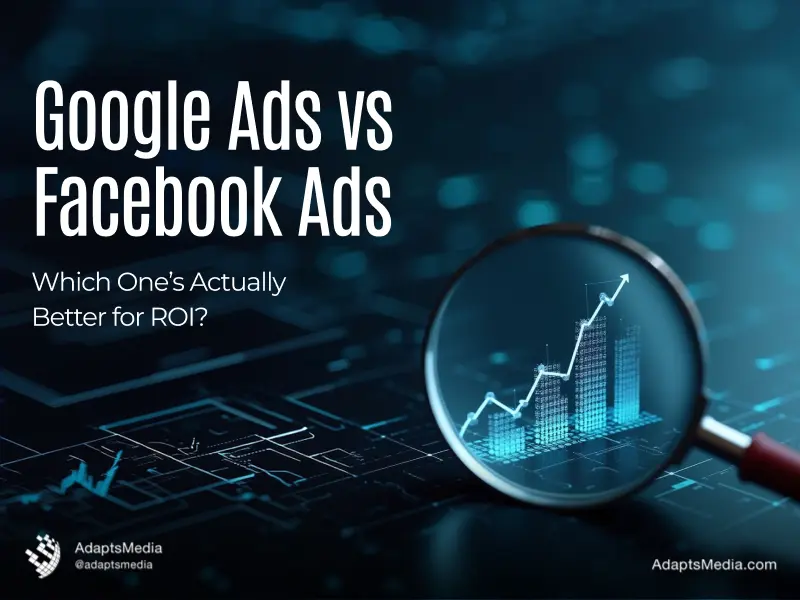
There’s no simple winner here. If someone says otherwise, they’re just overselling their favorite. Google Ads targets people who already know what they want and are often in the buying stage. Facebook Ads, on the other hand, spark interest in folks who weren’t even looking but are persuaded into thinking about your brand. Which one works better? It depends on what you’re selling, your profit margins, and how people usually find you in the first place.
- Meta serves over 3 billion people each month and has nearly 12 million businesses advertising.
- Google serves over 4 billion people each month, capturing the largest share of global ad budgets.
- A well-optimised Google campaign can give you $4 to $8 for every $1 spent.
- Meta (Facebook, Instagram, and more) floats somewhere between $3 and $5 for every $1 spent.
Google Ads vs Facebook Ads: The Quick Answer
Use Google Ads it comes under SEM services, when people are actively hunting for what you sell. Hit Facebook Ads to put your name out there, find new faces, or remind visitors you exist. The truth is, most businesses end up needing a mix of both.
- Google is king at the bottom of the funnel, catching serious buyers.
- Google Ads cost more, but those clicks bring high-intent customers.
- Meta excels at the top and middle of the funnel, finding new customers, sparking ideas, and convincing past visitors to come back.
- Clicks are cheaper, and creatives show off your product better, especially with retargeting.
In short, Google owns urgent, high-ticket buyers. Meta shines for visual products, impulse buys, and anything that does well when people see it a few times first.
How Google Ads and Facebook Ads Actually Work
Google Ads
- Google puts ads in front of people as soon as they type a search query.
- Its network spans Search, Shopping, YouTube, Display, Gmail, and Maps.
- Google uses AI-powered smart bidding to handle bids and ad placements.
- Example: It is perfect for search intents like “emergency AC repair” or “buy running shoes.”
Getting traffic but not enough leads? Explore our Google Ads guide to learn how to turn more clicks into valuable conversions.
Facebook Ads
Meta targets based on who you are and what you like.
People aren’t searching; they’re just scrolling, seeing something new pop up.
You’ll be on Facebook, Instagram, Reels, and Stories.
Example: Think of a fashion brand introducing a new collection to a lookalike audience on Reels.
Cost Breakdown: CPC, CPM, and ROAS
| Metric | Google Ads | Facebook/Meta Ads |
| Avg. CPC | $2.69 | ~$1.07 |
| Avg. CPM | ~$38.40 | ~$14.90 |
| Conversion behavior | Higher intent, higher CVR | Lower intent, broader reach |
| ROAS (optimised) | ~3.5:1 | ~3:1 to 5:1 (avg ~4.2x) |
| Time to results | 1–2 weeks (search) | 2–4 weeks (learning phase) |
| Best for | High-intent, urgent buyers | Awareness, visual / DTC, retargeting |
Table source: Stackmatix and AdsGo
Meta might be cheaper per click, but cheaper doesn’t always mean more profitable. Since Google catches people who already want what you sell, conversions are usually higher. Cost per acquisition matters more than just how much a click costs. Also, the difference can be wide by industry. For example, as per Ryze, legal pays ~$89 CPC on Google vs ~$3.20 on Meta (a 28x gap), while fashion is just ~$1.43 vs ~$0.81
Google Ads ROI: What to Expect in 2026
Google Ads ROI works best when someone’s already in the market, ready to buy.
- Google says the average is $2 back for each $1, but really strong accounts push to $3.50.
- If someone searches “buy [your product],” they’re 67% more likely to buy in a day than someone who just scrolls past your ad.
- Customers you get through Google also spend around 23% more with you in year one.
Facebook Ads ROI: What to Expect in 2026
Facebook Ads are a powerhouse for introducing new products, brand awareness, and bringing people back with retargeting.
- Well-run campaigns land between 3x and 5x your spend, usually settling around 4.2x.
- Low CPC plus powerful audience tools let you find and nurture cold leads cheaply.
- Right now, Reels alone make up more than 40% of Meta’s ad impressions.
Why the Best ROI Often Comes From Using Both
If you sync Google and Facebook together, you usually get a bigger return, 15–25% higher ROAS than just running one. The smart way:
- Top-of-funnel video and lookalikes on Facebook to attract new people.
- Google catches this same crowd once they start searching.
- Then Meta picks up stragglers with retargeting.
- Just don’t forget to tie your tracking together, or you’ll get misleading numbers.
Want to know what happens behind every successful ad campaign? Discover the role of ad operations in campaign execution, optimisation, and reporting.
Conclusion
Choosing a platform isn’t the goal. The real value comes from matching your ad spend to what you actually want to achieve, then measuring results the right way, like looking at your cost per acquisition and customer lifetime value. That’s where a team that’s focused on real outcomes steps in.
At Adapts Media, we manage Google and Facebook campaigns for businesses all over the UAE. But we don’t start with the platforms; we start with what your customers actually do and build everything around that. Unsure where your ad budget fits best? Let’s talk about it.
Frequently Asked Questions
Yes, Facebook is quite effective in short-term sales because of its social nature, which converts impulsive buyers faster than Google. However, since Facebook users are not scrolling to buy anything, your success depends entirely on how good your sales funnel is.
An ROI between 2:1 and 5:1 is considered a good ROI for Google. This also changes by industry. For e-commerce, an ROI between 3:1 and 5:1 is considered good, while for a service-based industry, an ROI of 1.5:1 to 3:1 is considered good.
It is an average estimate, meaning a brand is earning $2 on every $1 spent on Ads. This estimate changes from industry to industry, and anything above $3 is considered good, even though there is no ideal parameter for this.
Typically, Meta ads work best for e-commerce as they offer better visual product placements through reels and video ads and are best if your product solves real problems and is appealing to Gen Z and millennials.